Classic Neo-Amujan architecture: Difference between revisions
Jump to navigation
Jump to search
CMCollective (talk | contribs) No edit summary |
added Ŋərkish examples of classic Neo-Amujan architecture |
||
| (3 intermediate revisions by 3 users not shown) | |||
| Line 1: | Line 1: | ||
'''Classic Neo-Amujan architecture''' is an architectural style characterized by its box-like design scheme both inside and outside of the building as well as its lack of windows. The | '''''Not to be confused with [[Classical Amujan architecture]], which generally lacks raised rooves.''''' | ||
[[File:Shop-in-kaper-ribas.png|thumb|alt=Classic Neo-Amujan Shop in Kapę Ribas|Amujist Shop in [[Kapę Ribas]], [[Monke Island]]]] | |||
'''Classic Neo-Amujan architecture''' is an architectural style characterized by its box-like design scheme both inside and outside of the building as well as its lack of windows. The phrase was first coined by [[sq]] and was named after the [[City State of Amuj]], where it was first seen. Classic Neo-Amujan buildings are so minimalist that they often don't even use up any blocks for corners, leading to houses of this style commonly having rounded rooves or walls. Most of the house's shapes could be described as a "truncated cuboid". | |||
== Gallery == | == Gallery == | ||
| Line 7: | Line 10: | ||
KapeRibas.png|Classic Neo-Amujan architecture in [[Kapę Ribas]], [[Monke Island]], [[Kingdom of Kyaw Cen]] | KapeRibas.png|Classic Neo-Amujan architecture in [[Kapę Ribas]], [[Monke Island]], [[Kingdom of Kyaw Cen]] | ||
KiryacYikow.png|Classic Neo-Amujan architecture in [[Kiryac Yikow]], [[Monke Island]] | KiryacYikow.png|Classic Neo-Amujan architecture in [[Kiryac Yikow]], [[Monke Island]] | ||
Istangbul.png|Classic Neo-Amujan architecture in [[İstaŋbul]], [[Ŋərkey]] | |||
Aŋkara.png|The vizierial residence in [[Aŋkara]], [[Ŋərkey]], an example of classic Neo-Amujan architecture | |||
</gallery> | </gallery> | ||
Latest revision as of 13:45, 22 February 2026
Not to be confused with Classical Amujan architecture, which generally lacks raised rooves.

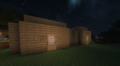
Classic Neo-Amujan architecture is an architectural style characterized by its box-like design scheme both inside and outside of the building as well as its lack of windows. The phrase was first coined by sq and was named after the City State of Amuj, where it was first seen. Classic Neo-Amujan buildings are so minimalist that they often don't even use up any blocks for corners, leading to houses of this style commonly having rounded rooves or walls. Most of the house's shapes could be described as a "truncated cuboid".
Gallery
This section is incomplete, you can help by expanding it
-
-
 Classic Neo-Amujan architecture in Kiryac Yikow, Monke Island
 -

-


